

Seeing Is a Skill. Why Doesn't the Design Industry Teach It?
What medicine, music, and a 1979 drawing book can tell us about the most neglected discipline in branding.
At Yale School of Medicine, first-year students are required to take a class at an art museum. They stand in front of paintings with the titles covered and describe, in detail, what they actually see. No interpretation. No diagnosis. Just observation. The programme was developed by dermatology professor Irwin Braverman, who believed that doctors were losing the ability to look carefully. Too much reliance on imaging and test results, not enough sustained attention to what was right in front of them. A study published in JAMA found that students who completed the training showed a measurable improvement in their ability to detect clinically relevant details. Nearly 70 medical schools now offer similar programmes.
The design industry, whose entire value proposition depends on visual perception, has nothing equivalent.
This is the question I’ve been sitting with since writing the last essay, which argued that perception, not production, is the real competitive advantage in branding. The response was generous and the agreement was widespread. But agreement isn’t the same as action. If we accept that seeing differently is the skill that matters most, we have to ask an uncomfortable follow-up: are we actually developing it in our people? Or are we just hoping they arrive with it?
Across most studios and agencies, the honest answer is the latter. Design education teaches craft, software, layout, typography, colour theory. It teaches people how to produce. What it rarely teaches is how to look. How to slow down in front of a brief and resist the gravitational pull of what the category already looks like. How to tell the difference between recognising something and actually seeing it. That distinction sounds abstract, but it has real consequences. A designer who recognises a category will produce work that fits. A designer who sees a category will find the opening everyone else has walked past.
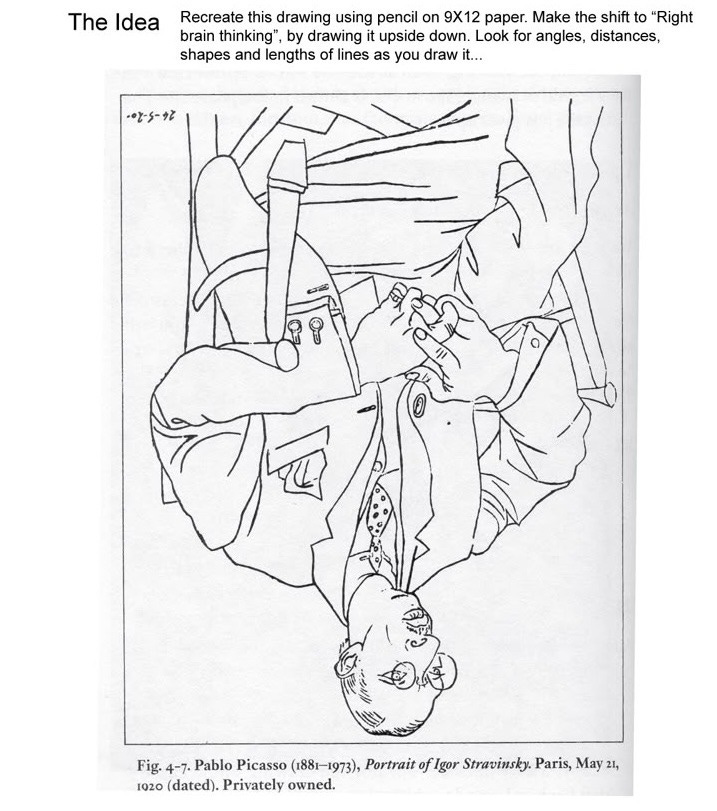
This isn’t a new problem. In 1979, Betty Edwards published Drawing on the Right Side of the Brain, which became one of the most widely translated art instruction books in history. Her central insight was that people who think they can’t draw aren’t lacking talent. They’re drawing what they think they see rather than what’s actually in front of them. They draw a symbol of an eye, not the specific arrangement of shadow, tone, and line that constitutes this particular eye in this particular light. Edwards designed exercises that forced students to bypass their assumptions, techniques like drawing a reference image upside down so the brain couldn’t default to its stored symbol. The results were dramatic. Students went from stick figures to credible portraits within days. The skill wasn’t new. It had been blocked by habit.
Edwards called this “learning to see.” She was explicit that it wasn’t limited to drawing. She saw it as a perceptual skill with applications across problem-solving, strategy, and creative thinking. She later wrote a follow-up, Drawing on the Artist Within, which applied these perceptual principles directly to business and professional creativity. Her argument was clear: perception can be trained, and organisations that train it will think better than those that don’t.
Branding desperately needs this lens. Consider how a typical brief moves through a studio. A competitive audit is conducted. A mood board is assembled. References are gathered. At every stage, the process is pulling the team toward what already exists. The tools themselves encourage pattern-matching rather than pattern-breaking. Semiotics, the study of how signs and symbols create meaning, offers a way to interrupt this. A semiotic reading of a category doesn’t ask “what does this look like?” It asks “what is this communicating, and to whom, and what assumptions has it baked in?” That’s a fundamentally different question, and it leads to fundamentally different work. But semiotics, like observational training in medicine, has to be practised as a discipline. It isn’t something you absorb by scrolling Pinterest.
The same principle holds across other fields that depend on perception. Musicians train their ear before they play a note. Sommeliers don’t just drink wine. They learn a structured method for isolating what they’re tasting: appearance, nose, palate, finish, each assessed separately before any conclusion is drawn. Radiologists go through years of learning to read images before they’re trusted with a diagnosis. In every case, the discipline is the same: slow down, separate observation from interpretation, resist the first conclusion, and develop a shared language for articulating what you notice. This is not innate. It is trained. And the people who train it consistently outperform those who rely on instinct alone.
The design industry has largely skipped this step. We hire for “a good eye” as though that’s a fixed trait rather than a developable capacity. We run critiques that jump straight to whether the work “feels right” without a shared framework for evaluating what the work is actually doing. And we wonder why so much brand output ends up looking the same, even when every brief claims to want something distinctive. The problem isn’t a lack of talent. It’s that we haven’t given talented people the tools to see past what’s already there.
Bruno Munari, who I wrote about last time, understood this instinctively. His entire practice was built on exercises in perception: describing everyday objects as though encountering them for the first time, building sculptures designed to change how you looked at space, cutting fruit in half and treating it as a printing tool. These weren’t eccentricities. They were a curriculum. Munari was training the capacity to defamiliarise, to strip the automatic response and look again. He knew that this had to be practised regularly, because the pull of familiarity never stops. The moment you think you’ve learned to see, habit is already creeping back.
What would it look like if the design industry took this as seriously as medicine does? If studios invested in structured observation training rather than assuming perception is something you either have or develop on your own? If the brief process began not with a competitive audit but with a deliberate exercise in looking at the category as though you’d never seen it before? If critiques had a shared language for distinguishing between work that fits a category and work that genuinely reframes it?
I don’t have all the answers yet. But I’m increasingly convinced that this is the gap. Not between studios that use AI and studios that don’t. Not between good taste and bad taste. The gap is between organisations that treat perception as a discipline and those that treat it as a personality trait. In a market where production is being automated and competent output is everywhere, the studios that protect and develop their people’s ability to see are the ones that will continue to matter.
The skill that matters most is the one we’ve never formally taught. It might be time to start.
Caterina Bianchini
Co-Founder & Executive Creative Director
NARI (Not Always Right Ideas)
Proofread by Claude.